Droven.io RPA & AI Automation Review 2026- Complete Guide, Features, Use Cases and ROI Analysis
In 2026, digital transformation is no longer optional. Companies across industries are adopting automation systems to reduce manual work, improve operational efficiency, and scale without increasing workforce size. Technologies like RPA (Robotic Process Automation), AI-driven workflows, and API-based integrations are now central to business operations.
Droven.io is positioned within this evolving ecosystem as a workflow automation and integration-focused platform. It helps businesses connect applications, automate repetitive tasks, and streamline operations using API-based workflows, triggers, and AI-supported logic systems.
This article provides a complete review of Droven.io including how it works, core features, real-world use cases, advantages, limitations, ROI considerations, and implementation strategies.
Discover Droven.io RPA and AI automation in 2026. Learn workflows, API integration, features, use cases, ROI, and real business limitations.
- What Is Droven.io?
- Why Businesses Use Droven.io in 2026
- How Droven.io Works (Automation Architecture)
- Core Features of Droven.io
- Business Use Cases of Droven.io
- API Automation vs Traditional RPA
- Advantages of Droven.io
- Limitations of Droven.io
- ROI and Cost Considerations
- Implementation Framework
- Key Risks and Challenges
- Future of Droven.io and Automation (2026)
- FAQ’s
- Conclusion
- Related post
What Is Droven.io?
Droven.io is a workflow automation platform designed to automate business processes using APIs, webhooks, triggers, and logic-based workflows. It focuses more on system integration and process automation rather than traditional UI-based robotic automation.
Unlike legacy RPA tools that simulate human actions on interfaces, Droven.io focuses on API-first automation, which makes it more stable, scalable, and suitable for modern cloud-based systems.
In simple terms, it allows businesses to connect multiple tools and automate workflows across them without manual intervention.
Why Businesses Use Droven.io in 2026
Modern organizations deal with fragmented systems such as CRMs, ERPs, marketing tools, communication platforms, and analytics dashboards. Managing these manually leads to inefficiencies, delays, and errors.
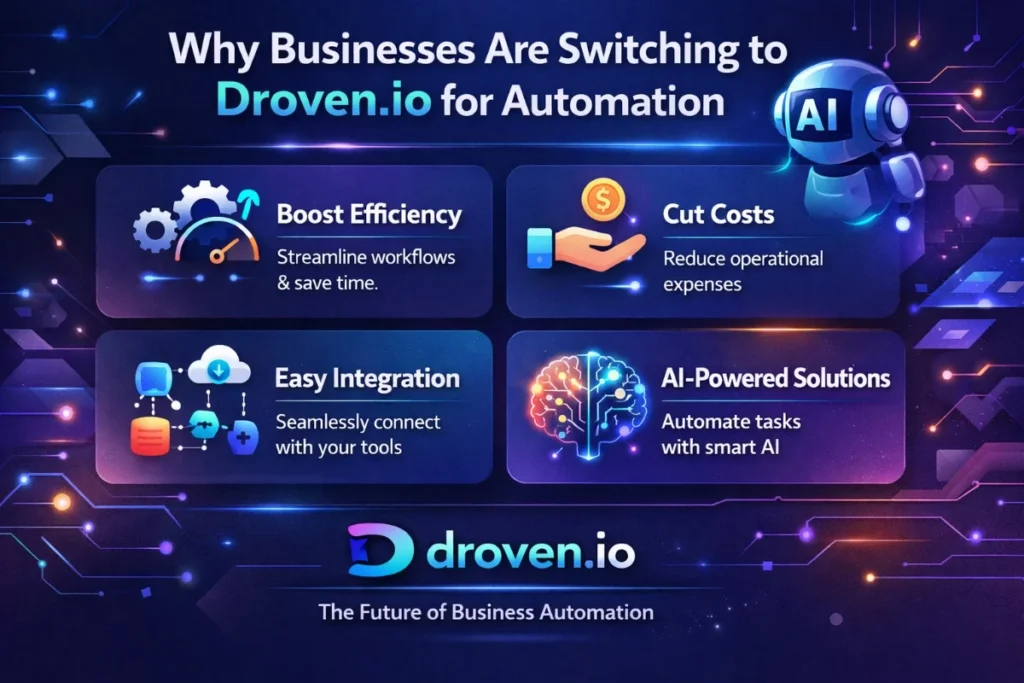
Automation platforms like Droven.io solve this problem by:
- Reducing manual repetitive tasks
- Connecting multiple SaaS applications
- Improving operational speed
- Ensuring consistent data flow
- Enabling real-time business automation
The main value lies in removing operational friction between disconnected systems.
How Droven.io Works (Automation Architecture)
A typical automation workflow in Droven.io follows a structured pipeline:
Trigger Layer
Automation starts when an event occurs, such as:
- Form submission
- Email received
- CRM update
- Payment confirmation
- Webhook event
Data Capture Layer
The system collects and extracts data from the trigger source using APIs or webhooks.
Processing Layer
At this stage, data is processed using:
- Rule-based logic
- Conditional workflows
- Optional AI-based classification or summarization
Workflow Engine
The workflow engine decides how data should move across systems based on predefined rules.
Action Layer
Actions are executed such as:
- Sending emails
- Updating CRM records
- Triggering notifications
- Storing data in databases
Logging and Monitoring
All activities are tracked for performance, debugging, and optimization.
This structure ensures automation flows are predictable, scalable, and traceable.
Core Features of Droven.io
API-Based Automation
The platform connects applications through REST APIs, enabling stable and scalable integrations. This reduces dependency on fragile UI-based automation systems.
Workflow Builder
Users can visually or logically design workflows using:
- triggers
- conditions
- actions
- routing logic
This allows non-technical teams to build automation systems.
Webhook Support
Webhook functionality enables real-time automation, ensuring systems respond instantly to changes in connected applications.
AI Logic Integration
Droven.io includes basic AI capabilities that help with:
- data classification
- content summarization
- workflow routing decisions
While not a full AI agent system, it enhances automation intelligence.
Browser-Based Automation (Limited RPA)
When APIs are not available, Droven.io can perform limited browser automation tasks such as form filling or data extraction. However, this is not its primary strength.
Multi-System Integration
The platform connects multiple business tools such as:
- CRM systems
- ERP platforms
- Marketing tools
- Spreadsheets
- SaaS applications
This allows unified data flow across departments.
Business Use Cases of Droven.io

Sales and CRM Automation
- Automated lead capture
- CRM updates
- Follow-up workflows
- Sales pipeline automation
Finance Automation
- Invoice processing
- Payment alerts
- Financial reporting workflows
- Expense tracking automation
Customer Support Automation
- Ticket classification
- Auto-response generation
- Priority routing
- Support workflow automation
Operations Automation
- Inventory updates
- Order management
- Supplier coordination
- Internal workflow routing
Marketing Automation
- Campaign triggers
- Email automation
- Customer segmentation
- Lead nurturing workflows
API Automation vs Traditional RPA
Automation is shifting from UI-based systems to API-first architectures.
API-Based Automation (Droven.io Strength)
- Highly stable
- Fast execution
- Easy scaling
- Low maintenance
- Reliable integration
Traditional RPA (UI-Based Automation)
- Works without APIs
- High maintenance cost
- Breaks when UI changes
- Slower execution
- Less scalable
This makes API automation more suitable for modern cloud environments.
Advantages of Droven.io
- Fast workflow creation
- Strong API integration capabilities
- Real-time automation support
- Flexible system connectivity
- Suitable for mid-level business automation
These strengths make it effective for companies transitioning to digital workflows.
Limitations of Droven.io
Despite its advantages, there are limitations:
- Not a full enterprise RPA platform
- Limited advanced AI capabilities
- Browser automation is less reliable than APIs
- Requires technical understanding for complex workflows
- Not suitable for mission-critical enterprise systems
These limitations are important when evaluating scalability needs.
ROI and Cost Considerations
Automation ROI depends heavily on process design quality.
High ROI Use Cases
- Lead management
- CRM synchronization
- Reporting automation
- Notification systems
Low ROI Use Cases
- Complex financial systems
- Legacy system automation
- High-risk operational workflows
Cost Factors
- Subscription fees
- Implementation time
- Maintenance requirements
- Risk of workflow failure
Poorly designed automation systems can increase operational risk instead of reducing cost.
Implementation Framework
A structured approach is essential for successful automation:
Identify Processes
Select repetitive, high-volume tasks.
Map Workflows
Define every step clearly before automation.
Select Automation Type
Choose between API, AI-based logic, or limited RPA.
Build Workflow Logic
Define triggers, conditions, and actions.
Testing Phase
Test workflows using real data scenarios.
Deployment
Launch workflows with monitoring enabled.
Optimization
Continuously improve performance and reduce errors.
Key Risks and Challenges
Automation systems often fail due to:
- Poorly designed workflows
- Lack of error handling mechanisms
- Overdependence on AI decisions
- Integration complexity across systems
- Insufficient monitoring and maintenance
Automation amplifies existing process quality; it does not fix broken systems.
Future of Droven.io and Automation (2026)
The automation industry is evolving toward:
- Hyperautomation ecosystems
- AI-driven decision systems
- Self-healing workflows
- Autonomous AI agents
- Fully integrated digital operations
For Droven.io to remain competitive, it must expand into deeper AI integration, enterprise scalability, and advanced automation intelligence.
FAQ’s
1. What is Droven.io used for?
Droven.io is used for workflow automation, API integration, and business process automation across multiple systems.
2. Is Droven.io an RPA tool?
It includes limited RPA-like features but mainly focuses on API-based automation.
3. Can beginners use Droven.io?
Yes, basic workflows are easy to build, but advanced automation requires technical understanding.
4. Is Droven.io suitable for large enterprises?
It is better suited for mid-level automation rather than large-scale enterprise RPA systems.
5. What industries benefit most from Droven.io?
Sales, marketing, finance, customer support, and operations benefit the most.
Conclusion
Droven.io is a modern API-based automation platform designed to streamline workflows, connect systems, and reduce manual effort. It is effective for structured business processes but not a replacement for enterprise-grade RPA systems. Its strength lies in integration flexibility, workflow automation speed, and simplicity, making it ideal for businesses adopting scalable automation strategies in 2026.